
40 Hz gamma stimulation: 69% less brain volume loss in a 6-month trial in Alzheimer's disease
What 40 Hz gamma stimulation is, how "gamma music" is built, what the human trials actually showed — and how to use a 40 Hz album like Gamma Focus 25 in practice.
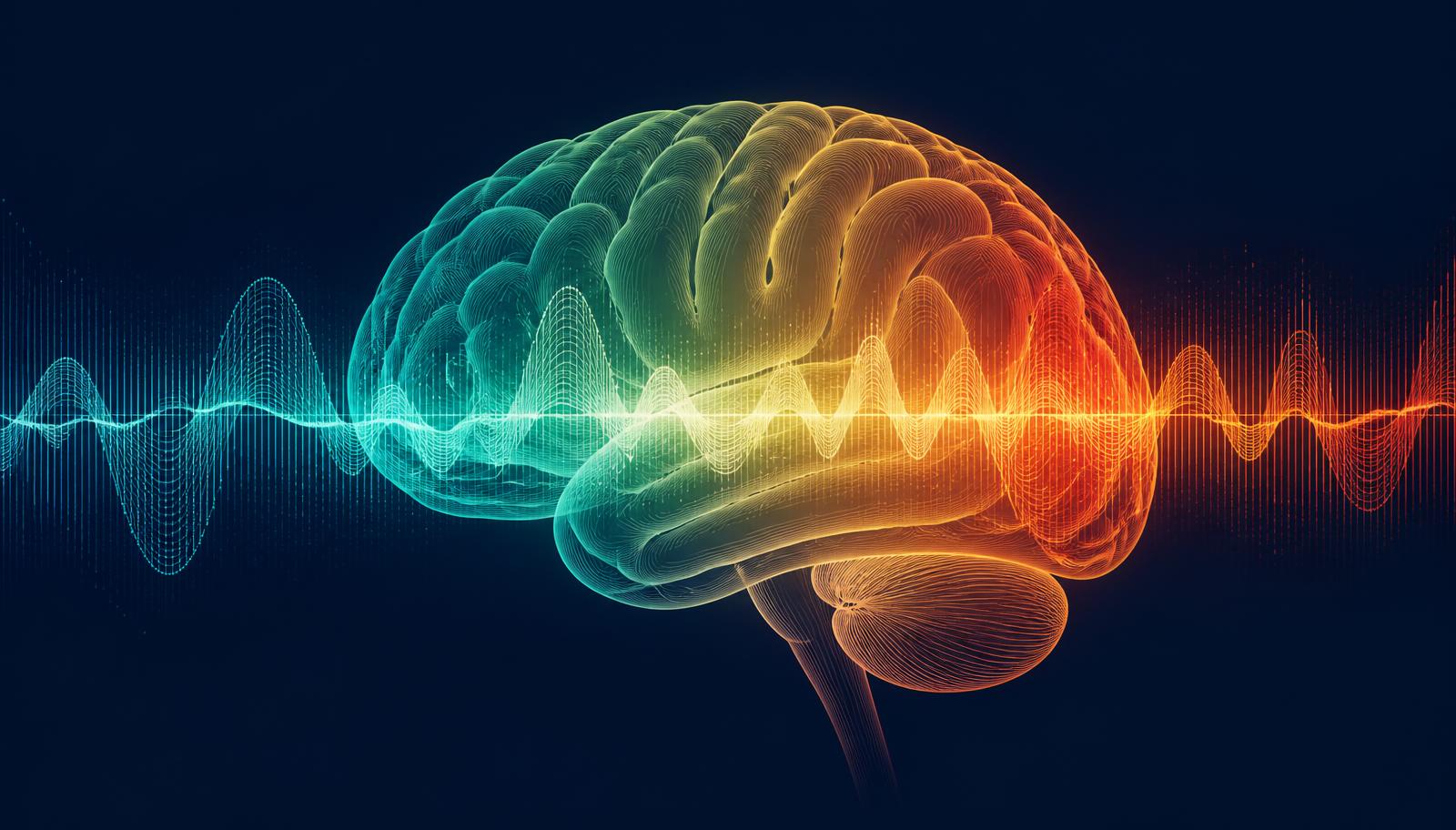
Dementia and mild cognitive impairment (MCI) often develop gradually: memory feels more fragile, mental fatigue comes faster, and over time this can reduce everyday energy and independence. That is why researchers are looking for methods that are non-invasive, can be used at home, and might slow progression.
One of the most interesting research tracks in recent years is 40 Hz "gamma" stimulation: sound and/or light pulsing 40 times per second, designed to help the brain lock in to a 40 Hz rhythm. In a 6-month randomised, double-blind, sham-controlled study (OVERTURE), 76 people with mild-to-moderate Alzheimer''s disease (MMSE 14-26) used a home device 1 hour daily, which evoked EEG-confirmed gamma oscillations through sensory stimulation.
The two headline numbers
- 69% less loss of total brain volume in the active group versus control after 6 months. In plain English: less overall shrinkage, which typically tracks progression.
- 77% less decline in daily functional ability, measured with ADCS-ADL — a scale for how well a person manages everyday activities and independence.
These are unusually large numbers for this field, and they come from people who already had Alzheimer''s disease. They are not a promise of anything for a healthy brain. But they are a strong signal that the 40 Hz rhythm is doing something real.
What "gamma" and 40 Hz actually mean
The brain operates in rhythms. Gamma rhythms (roughly 30-80 Hz) are linked to attention, sensory integration and information processing. 40 Hz has become a sweet spot, because the brain synchronises to it relatively easily when the stimulation is steady and repetitive.
When you deliver a stable 40 Hz rhythm — a light flicker, or a pulsing change in sound energy — you can measure the brain responding with a 40 Hz signature on EEG. For sound, this is called the auditory steady-state response (ASSR).
What is 40 Hz gamma music?
Pure 40 Hz tones sound sharp and can quickly become irritating. That is why research has explored embedding 40 Hz inside music — so it is more pleasant, and therefore easier to use for longer.
A recent EEG study introduced "gamma music", where instruments (drums, bass, keys) carry a 40 Hz component. Researchers observed clear peaks in 40 Hz power and phase-locking — a robust ASSR — while participants rated the experience as more pleasant than raw 40 Hz stimulation.
The simple principle behind a 40 Hz album
Gamma Focus 25 by Sundance12 is one example of a 40 Hz gamma-music album — the one we currently point to, because it is built exactly this way. Other artists may well release comparable albums, and the mechanism is not tied to any single release.
- The music is designed to be genuinely enjoyable (ambient, downtempo, lo-fi, electronic, piano pads).
- Underneath, it carries a 40 Hz amplitude modulation — a subtle pulse in loudness and energy.
- The result is music that is aesthetic, but also targeted at evoking a 40 Hz auditory response.
Listen: Apple Music · Spotify · YouTube Music
Mechanism 1: ASSR — the brain syncs to the beat
ASSR means the brain synchronises part of its activity to the rhythm it is fed — here, 40 Hz. It shows up on EEG as a clear 40 Hz signature.
What that does for you: ASSR is first of all evidence that the stimulation is actually reaching the nervous system. Think of it as a receipt from the brain: "I am receiving the rhythm, and I am responding." In research, the 40 Hz response is also used as a marker of the brain''s ability to coordinate rhythmically — something that is often weakened in cognitive impairment.
Mechanism 2: clean-up and repair (strong in animals, human evidence still developing)
In animal models of Alzheimer''s disease, 40 Hz entrainment has been associated with changes in:
- Amyloid-beta and tau — proteins that can accumulate and are linked to disease processes
- Microglia — the brain''s immune cells, involved in clean-up and inflammatory responses
- Neuroinflammatory signalling — immune messaging in the brain
Iaccarino and colleagues showed that driving neural activity at 40 Hz in mice reduced amyloid-beta levels and altered microglia. Other studies reported improvements in Alzheimer''s-related markers and cognition in mice, and more recent data suggest a possible connection to glymphatic fluid flow — the brain''s wash and drain system.
What that does for you: if these mechanisms translate, fully or partly, to humans, the potential is not only better focus right now, but slower loss of brain structure and function over time. The most convincing clean-up data are still primarily from animals, and human trials are not yet definitive.
What the human trials showed — and who took part
It is important to be explicit: the most cited clinical results so far come from studies in people who already had probable Alzheimer''s disease, not healthy participants. We cannot automatically assume the same effects in healthy people, in MCI, or in subjective cognitive impairment.
6 months: slower progression in mild-to-moderate Alzheimer''s disease
In OVERTURE (MMSE 14-26), participants used a 40 Hz sensory stimulation device at home for 1 hour daily. Researchers observed, as secondary and descriptive results:
- 77% less decline in daily function (ADCS-ADL)
- 76% less decline on MMSE, a short temperature check of cognition
- 69% less loss of total brain volume
There was no significant change in amyloid-PET over 6 months, suggesting any potential benefit was not driven by plaque removal within that timeframe.
3 months: structural and cognitive signals in a pilot
In a smaller 3-month pilot, also 1 hour daily at home, researchers observed a significant difference in ventricular enlargement: about 4.34% in the control group versus 1.33% in the active group. Ventricles are the brain''s fluid-filled spaces; as tissue loses volume, ventricles tend to enlarge, so less enlargement may indicate slower structural change. Participants also performed better on a face-name associative memory test.
Dose: how much is needed?
The honest answer:
- The strongest clinical signals in humans come from daily use of around 1 hour, over weeks to months.
- We do not have strong data saying that 10 minutes is enough, or that 25 minutes gives a specific share of the effect.
- Music has a practical advantage: it makes it far easier to accumulate many minutes without the fatigue of a raw stimulus.
How to use a 40 Hz album in practice
A 40 Hz focus album is built for focus sessions: short tracks you can run as a set of roughly 25 minutes. It makes most sense while working, reading, writing or planning — whenever you want a cognitive backdrop. It is not sleep music: gamma stimulation is linked to attention and processing rather than falling asleep.
A simple starter protocol
- Week 1: one set (~25 minutes) daily at moderate volume.
- Weeks 2-4: one to two sets (~25-50 minutes) daily.
- To approximate the dosing used in human studies: aim for 45-60 minutes per day in total. This is a practical translation of study dosing, not a proven minimum.
Safety and comfort
- Start low in volume.
- If you are prone to headaches or tinnitus, be conservative — tinnitus and headache were reported more often in the active group in one study.
- If you have epilepsy or seizure risk, be especially cautious with flickering light. Sound is typically less problematic than strobe-like light, but talk to your clinician if in doubt.
Practical listening tips
Headphones or speakers. Both can work for 40 Hz amplitude modulation. The key is that the pulse is not lost to poor playback or background noise. Headphones often work best in practice, especially for focus work.
Volume. Aim for pleasant background sound, not concert level. Too loud causes fatigue and makes sustained focus harder.
Can you work at the same time? Yes — that is one of the most natural use cases, especially for writing and analytical tasks. For anything requiring listening focus (meetings, language work, music production), turn it off or use a neutral track.
Session length. For focus, 10-30 minutes Pomodoro-style is a good start. In research the pattern is daily exposure over weeks and months, so think repeatable routine rather than quick fix.
Realistic expectations
Short term, some people report better flow and a calmer mind; others do not feel much. The long term is where the research is most interesting — and also where we still need larger, decisive trials. Current results are promising, not final.
References
- Chan, D., et al. (2022). Gamma frequency sensory stimulation in mild probable Alzheimer''s dementia: feasibility and pilot studies. PLOS ONE.
- Hajós, M., et al. (2024). Safety, tolerability, and efficacy estimate of evoked gamma oscillation in mild to moderate Alzheimer''s disease. Frontiers in Neurology.
- Yokota, Y., et al. (2024). Gamma music: a new acoustic stimulus for gamma-frequency auditory steady-state response. Frontiers in Human Neuroscience.
- Iaccarino, H. F., et al. (2016). Gamma frequency entrainment attenuates amyloid load and modifies microglia. Nature.
- Martorell, A. J., et al. (2019). Multi-sensory gamma stimulation ameliorates Alzheimer''s-associated pathology and improves cognition. Cell.
- Garza, K. M., et al. (2020). Gamma visual stimulation induces a neuroimmune signaling profile distinct from acute neuroinflammation. Journal of Neuroscience.
- Murdock, M. H., et al. (2024). Multisensory gamma stimulation promotes glymphatic clearance of amyloid. Nature.
This article is educational and is not medical advice.
Written by
Longevity Institute
Evidence, education and innovation for healthy longevity. Reviewed against our editorial and compliance standards.
This article is for educational purposes and is not medical advice. Always consult a qualified health professional about medical concerns.
Next step